Let’s be honest: in 2026, the DTC landscape feels more like a survival of the smartest than a race to the biggest ad spend. With customer acquisition costs climbing and the efficiency of paid channels hitting a plateau, scaling a brand has become a high-stakes puzzle. Growing isn’t just about spending more anymore; it’s about growing with intention.
Modern DTC growth marketing has evolved into a deeply connected system. It’s no longer enough to look at acquisition in a vacuum; you have to see how it breathes alongside your conversion, retention, and data strategies. For brands navigating Shopify Plus marketing, success comes from aligning these elements rather than treating them as isolated tasks.
This guide breaks down 10 practical and proven growth marketing strategies to help you build a scalable and profitable eCommerce growth strategy.
What Is DTC Growth Marketing?
DTC marketing (Direct-to-Consumer) means selling directly to your customers without intermediaries. But in 2026, it goes beyond ownership, it’s about controlling the full customer experience.
Growth marketing in this context is a full-funnel approach. It focuses on continuously improving every stage of the journey, from first interaction to repeat purchase, using data, testing, and optimisation.
Unlike traditional digital marketing approaches that often focus only on acquisition, DTC growth marketing connects acquisition, conversion, and retention into one unified system.
Why Growth Marketing for DTC Brands Matters in 2026?
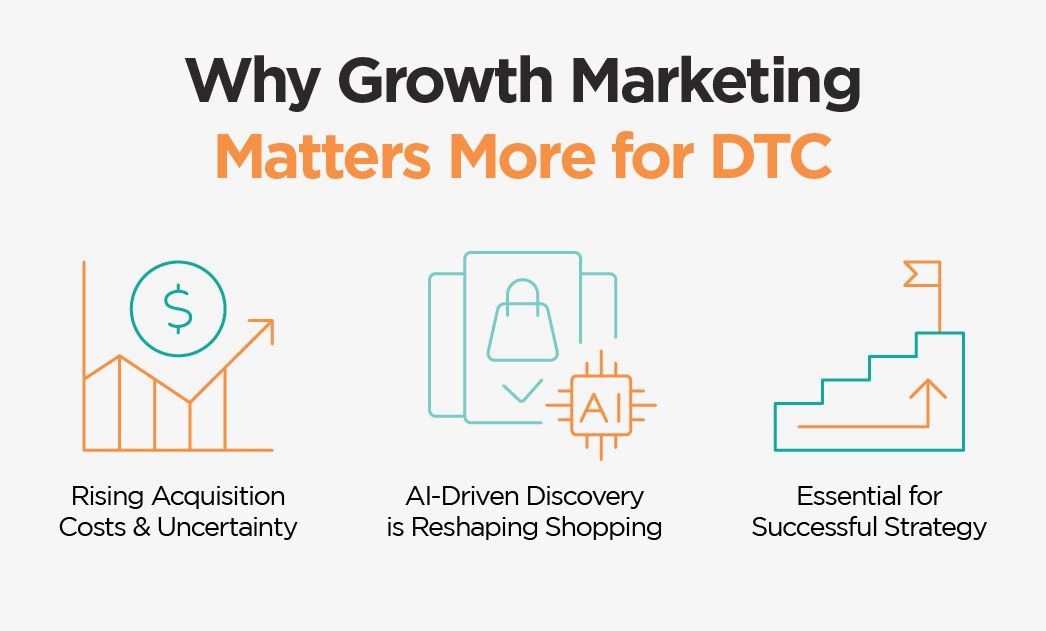
Relying on a single, predictable ad channel is becoming a risky gamble. Acquisition is more expensive and less certain than ever, which is why your “owned” audiences are becoming your most stable source of profit.
We are also seeing AI-driven discovery reshape how people shop. Visibility is no longer just about where you sit in search rankings; it’s about whether your brand is referenced and summarised within AI-generated answers.
Consequently, a successful strategy now requires a much stronger customer retention strategy, structured content, and messaging that resonates across both search engines and generative platforms.
The 10 Growth Marketing Strategies DTC Brands Should Focus On
1. Build Your Strategy Around First-Party Customer Data
In modern DTC growth marketing, data is your biggest competitive advantage. First-party data helps you understand customer behaviour without relying on third-party platforms.
Key sources include:
Email sign-ups and subscription data
Quiz responses and zero-party inputs
Purchase history and transaction data
Browsing behaviour and on-site interactions
Post-purchase surveys and feedback
This data allows for better segmentation and more personalised campaigns. For DTC marketing teams, this doesn’t just increase efficiency; it helps you create content that performs better in both traditional SEO and AI-driven searches.
2. Optimise Product & Landing Pages Before Scaling Traffic
There is nothing more expensive than sending traffic to a page that doesn’t convert. Your pages need to be friction-free zones that answer a buyer’s questions before they even ask them.
In Shopify marketing, well-structured pages also help AI systems “read” your content more effectively, increasing your discoverability.
3. Align SEO and GEO
In 2026, SEO alone is not enough. You also need GEO (Generative Engine Optimisation) to ensure your content is selected and cited by AI systems. Both should be treated as one unified growth marketing strategy.
Effective content should include:
Clear definitions and explanations
Comparisons and decision-making frameworks
Practical, actionable insights
Coverage of real customer and operational questions
A capable growth marketing agency will prioritise this alignment between GEO (Generative Engine Optimisation) and SEO to ensure you are visible wherever a customer starts their search.
4. Create Topic Clusters Around Real DTC Growth Problems
Random blog posts won’t move the needle long-term. Instead, build your content around the actual business challenges your customers face.
Key topic clusters may include:
Customer retention strategy
Shopify growth strategy
Customer acquisition
Lifecycle marketing
Conversion optimisation
Topic clusters build your authority and make it easier for AI systems to associate your brand with specific expertise.
5. Use Shopify Marketing as a Growth Engine
Shopify marketing should be more than just a series of promotions. It needs to integrate your storefront experience, merchandising, and automation into one seamless system.
When optimised effectively, Shopify enables:
Smoother customer journeys
Higher engagement and conversion rates
Scalable growth infrastructure
For DTC teams, the platform itself becomes the engine of your performance.
6. Prioritise Customer Retention Strategy
Many brands still pour money into the top of the funnel while letting the bottom leak. A strong customer retention strategy can drastically improve your margins without adding a cent to your ad spend.
Effective retention tactics include:
Email lifecycle flows
Loyalty programmes and rewards
Replenishment and reorder reminders
Personalised offers and segmentation
7. Turn Email & Lifecycle Marketing Into Revenue Drivers
Email remains one of the highest ROI channels in growth marketing for eCommerce. But it must be used strategically, not just for promotions.
Key automated flows include:
Welcome sequences
Abandoned cart reminders
Browse abandonment emails
Post-purchase engagement
Win-back campaigns
Replenishment reminders
8. Improve Content for Mid-Funnel Education and Comparison Intent
Don’t ignore the people who aren’t ready to buy right this second. They need help making a decision.
Mid-funnel content should help users:
Compare products or solutions
Understand product categories
Solve specific problems
Evaluate different options
9. Measure Growth Using Revenue-Centred Metrics
Vanity metrics like clicks and impressions don’t reflect real business performance. Modern growth marketing strategies focus on revenue-driven metrics.
Key indicators to focus on include:
Customer acquisition cost (CAC)
Lifetime value (LTV)
Average order value (AOV)
Conversion rate
Repeat purchase rate
Retention
10. Work With a Growth Marketing Agency That Understands DTC Commerce
Not every agency is built for the nuances of D2C eCommerce. You need a partner that understands data, retention, and the specific Shopify marketing infrastructure.
A unified approach should integrate:
SEO and GEO
UX and conversion optimisation
Lifecycle marketing
Paid acquisition strategies
Common Growth Marketing Mistakes DTC Brands Still Make
Even the best brands can fall into these traps:
Scaling paid traffic before the website is actually ready to convert.
Publishing content without a clear topic strategy.
Neglecting the customer the moment the first purchase is made.
Treating Shopify purely as a checkout tool rather than a platform for experience.
Focusing on surface-level metrics rather than actual profitability.
Failing to structure content for AI makes the brand invisible to generative platforms.
The difference between brands that plateau and those that scale is alignment. When acquisition, experience, and retention work together, growth becomes more predictable, more profitable, and more sustainable.
Growth in 2026 Requires Visibility, Conversion, and Retention
In today’s landscape, growth isn’t driven by isolated tactics. It requires a coordinated effort that balances how you are seen, how you convert, and how you keep your customers. Brands that invest in both SEO and GEO will be best prepared for how people search today.
If you are looking to solidify your Shopify growth strategy, working with an experienced growth marketing agency can provide the clarity and expertise needed to turn these strategies into measurable growth.
Ready to take the next step? Partner with Verz Design and unlock smarter, more sustainable growth for your business.
Frequently Asked Questions
What is growth marketing for eCommerce brands?
It’s a full-funnel approach focused on sustainable revenue through constant optimisation across the whole journey.
How is DTC marketing different from traditional marketing?
DTC marketing focuses on direct customer relationships, data ownership, and long-term value instead of one-time transactions.
Why is a customer retention strategy important?
It drives profitability by reducing your reliance on expensive paid ads and building a loyal base.
What does a growth marketing agency do?
They integrate all your channels, SEO, paid, and lifecycle, into one cohesive eCommerce growth strategy.
About the Author:
Bea Dyra Boquiron
Content writing has been a rewarding journey for Dyra, opening up numerous opportunities for her to explore her creativity, sharpen her skills, and connect with people from all walks of life. She loves being able to turn thoughts and ideas into something meaningful, finding fulfillment in seeing how her words...
Contributors:
Kyndall Dane Cesar
Senior SEO Specialist
Vivek Tank
Senior SEO Specialist
Need a strong team specialised in SEO?
Speak to Verz today if you are looking to create a website with a lasting impression to achieve online success.



 Share